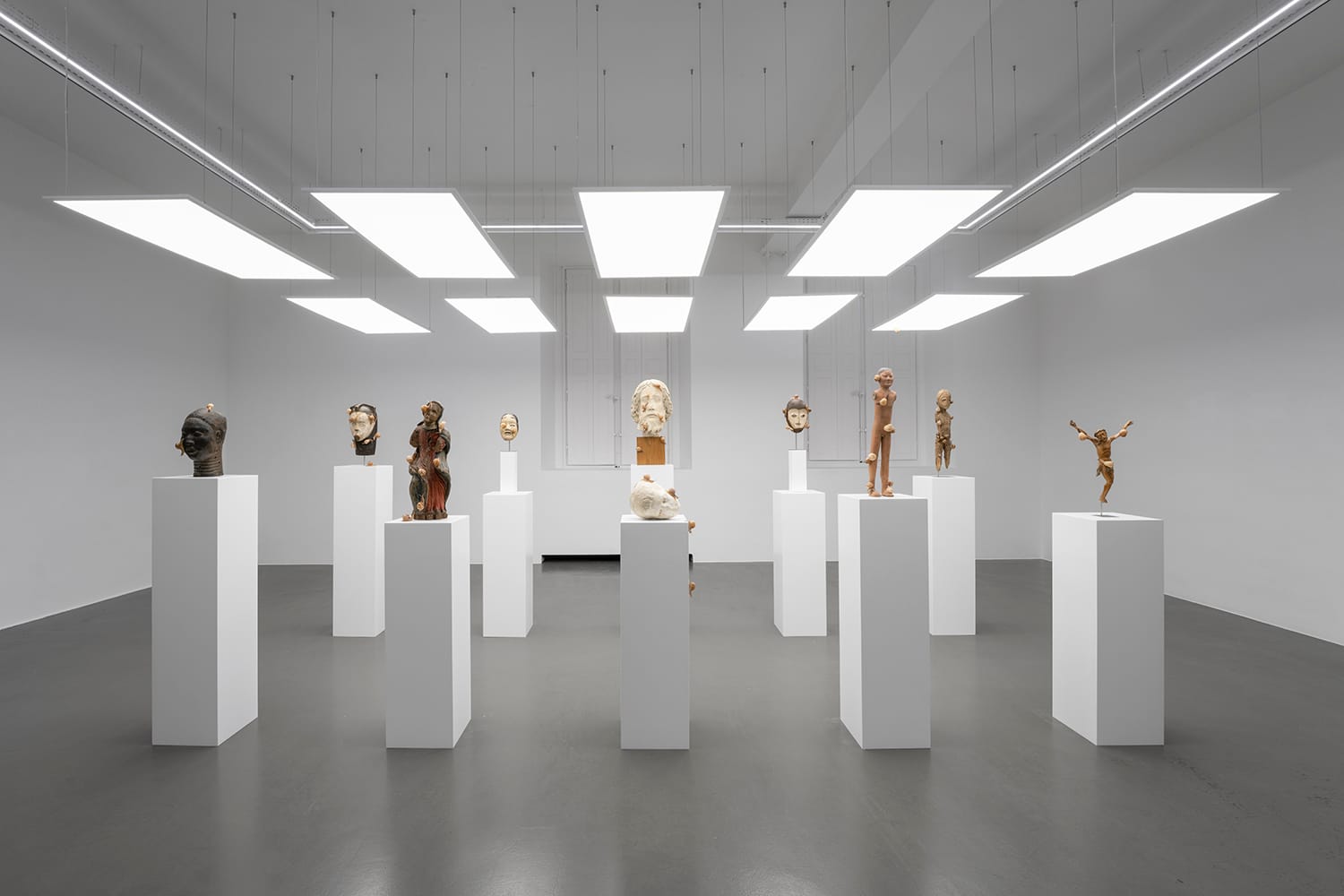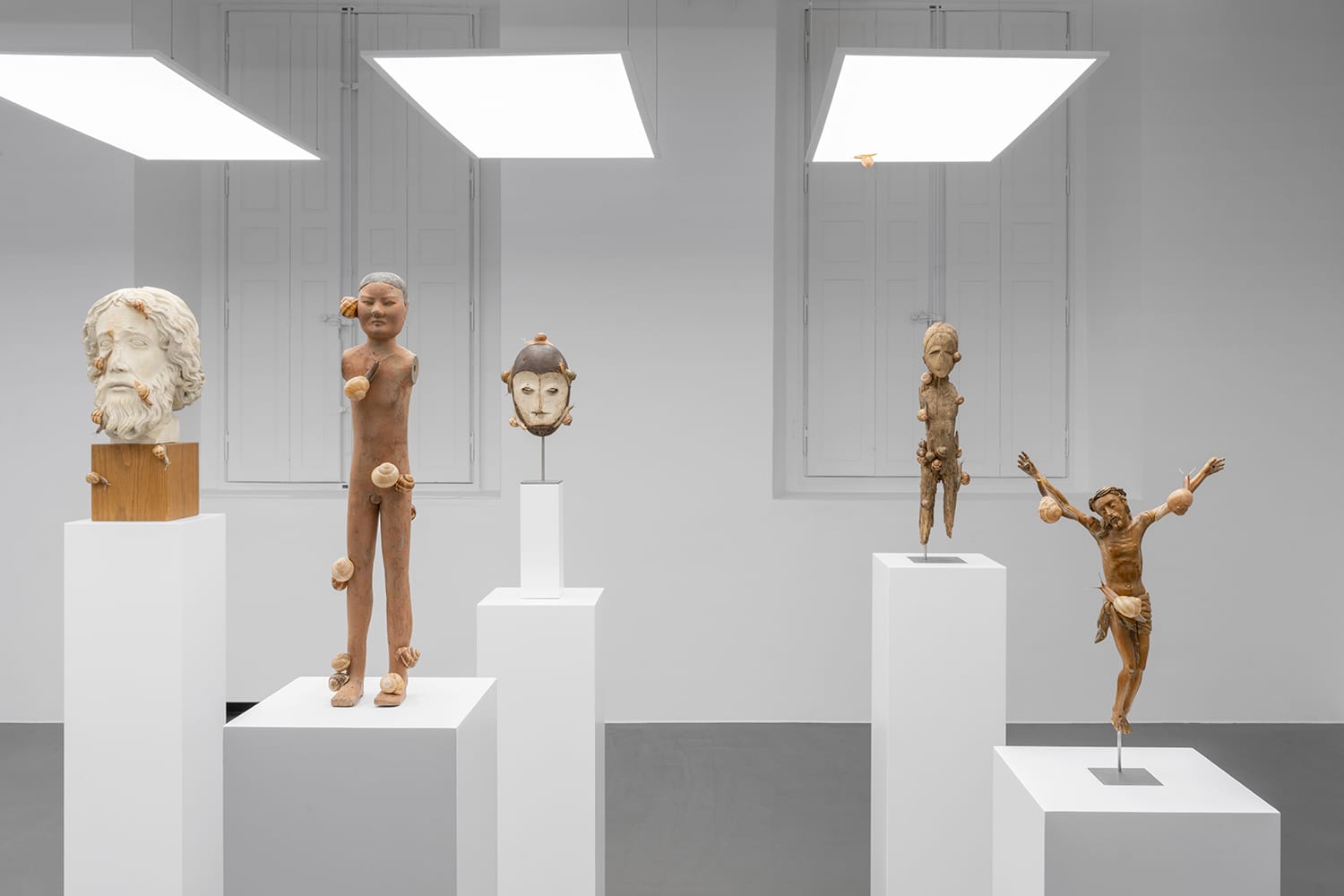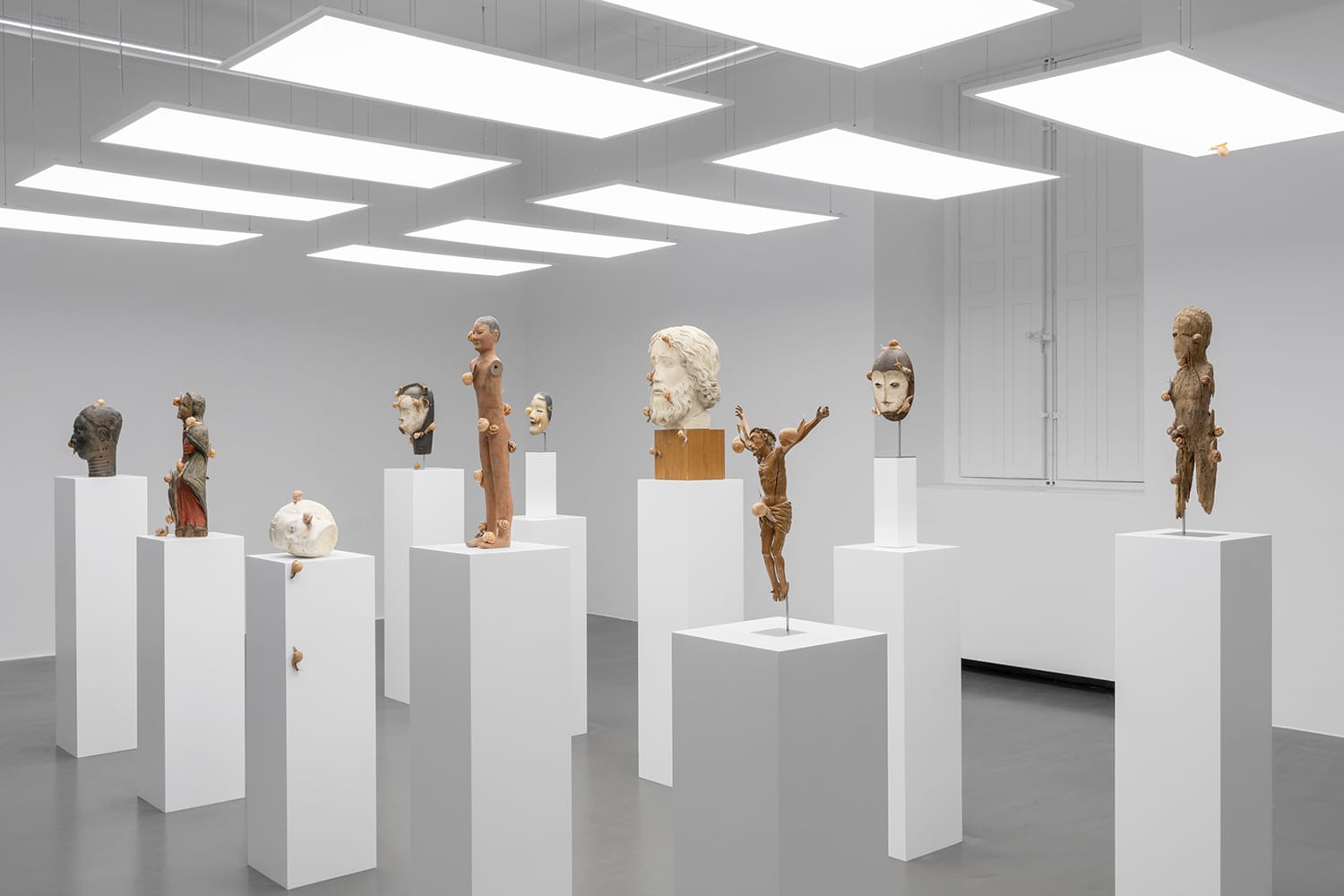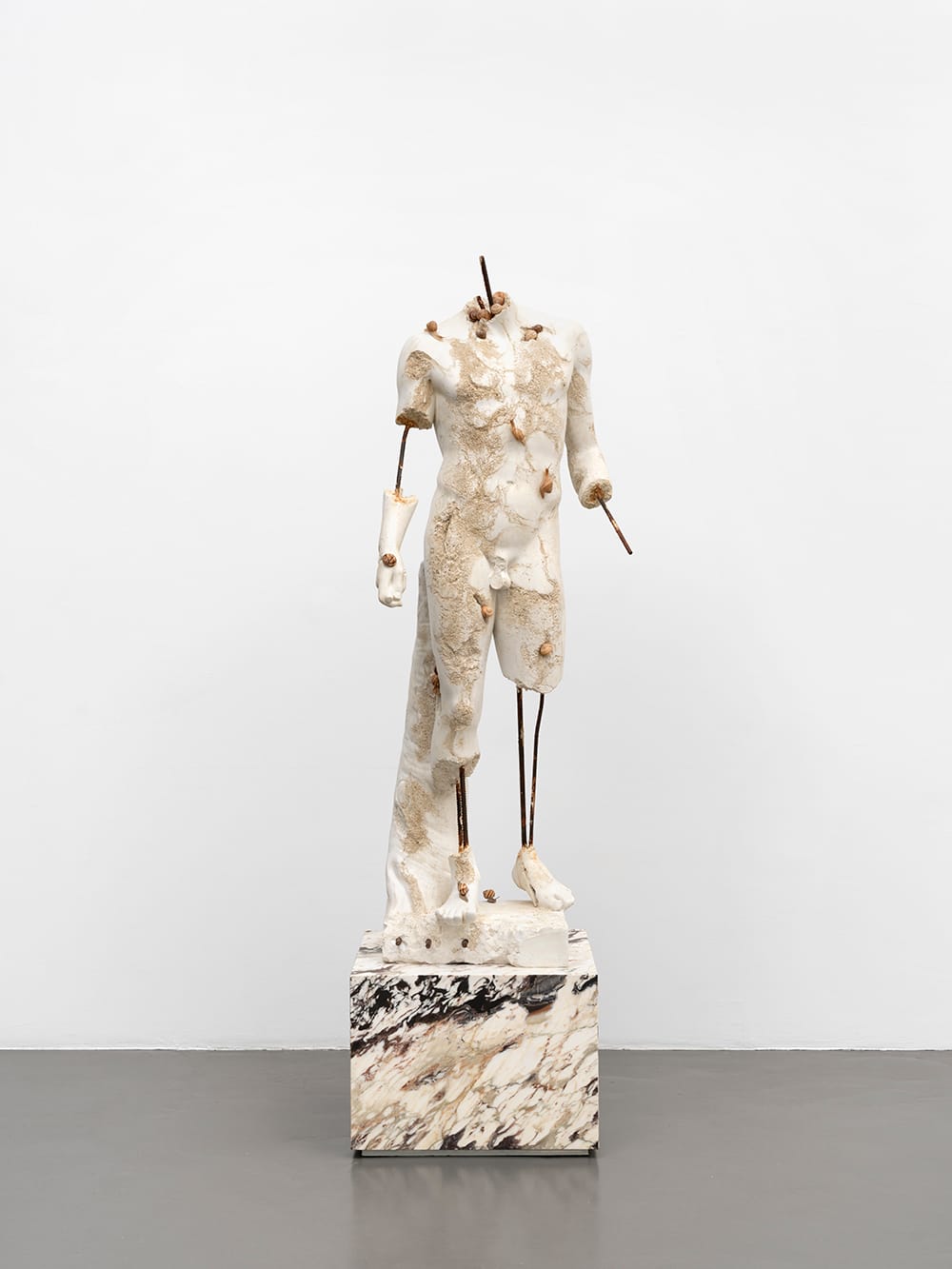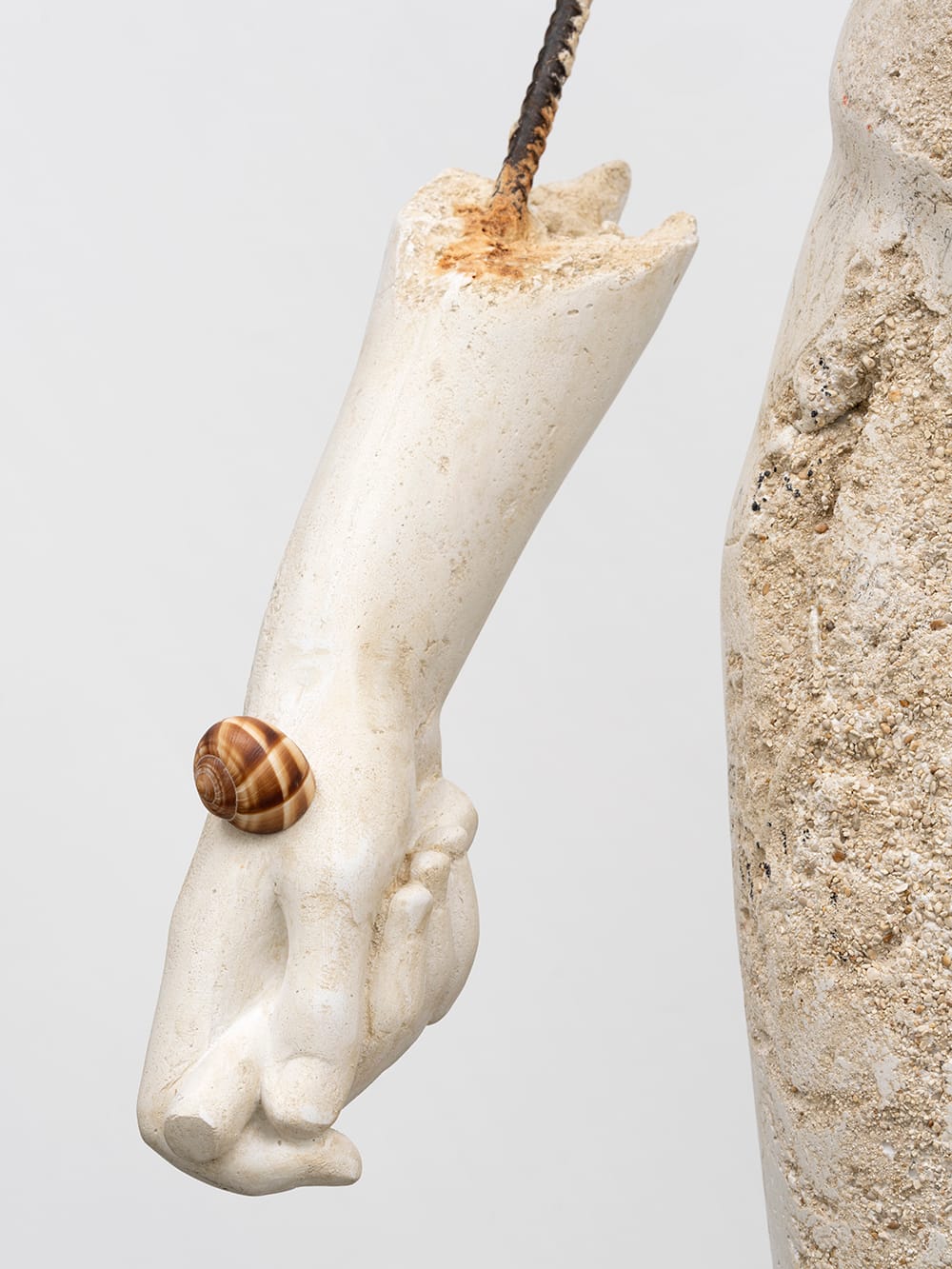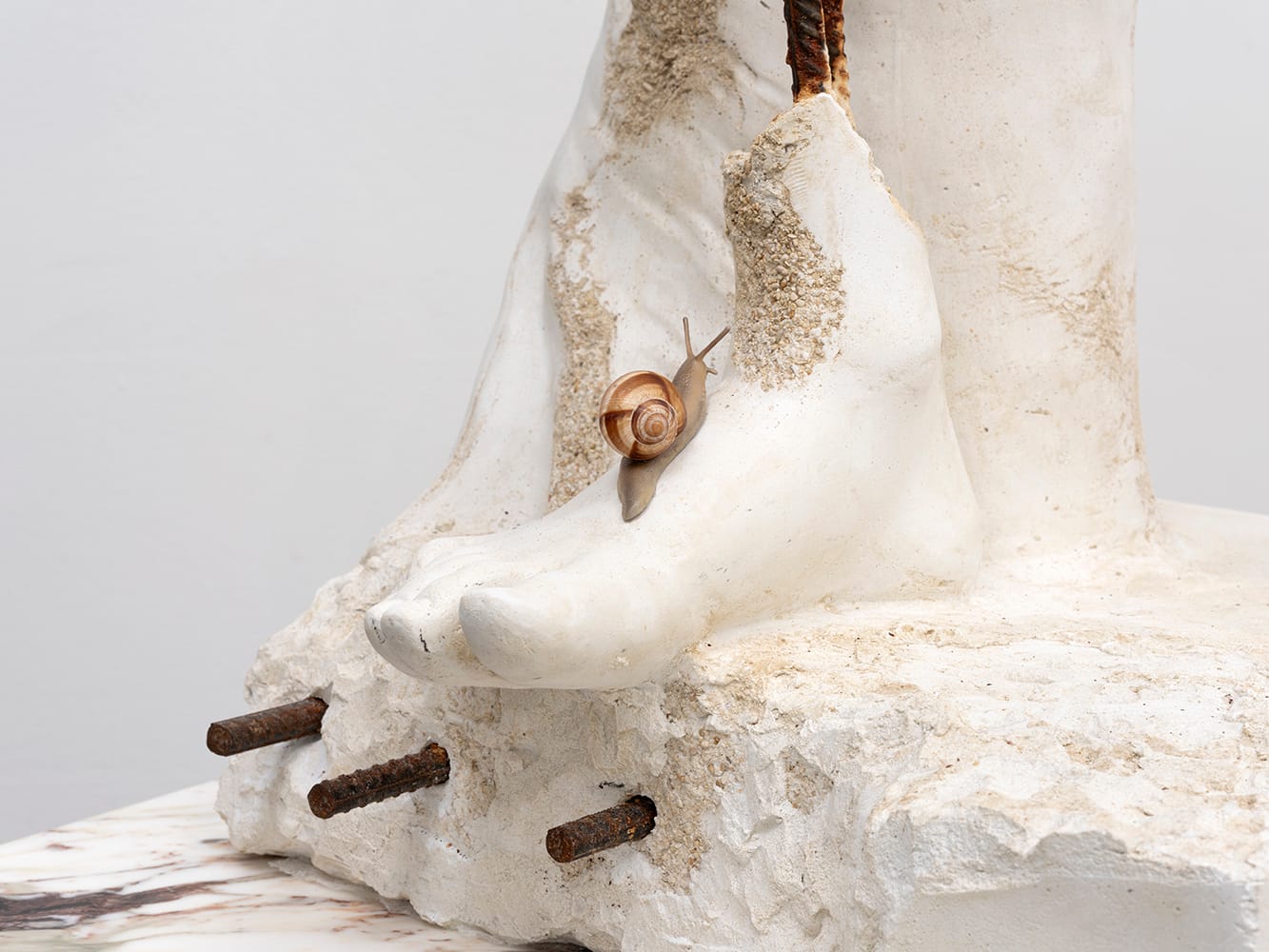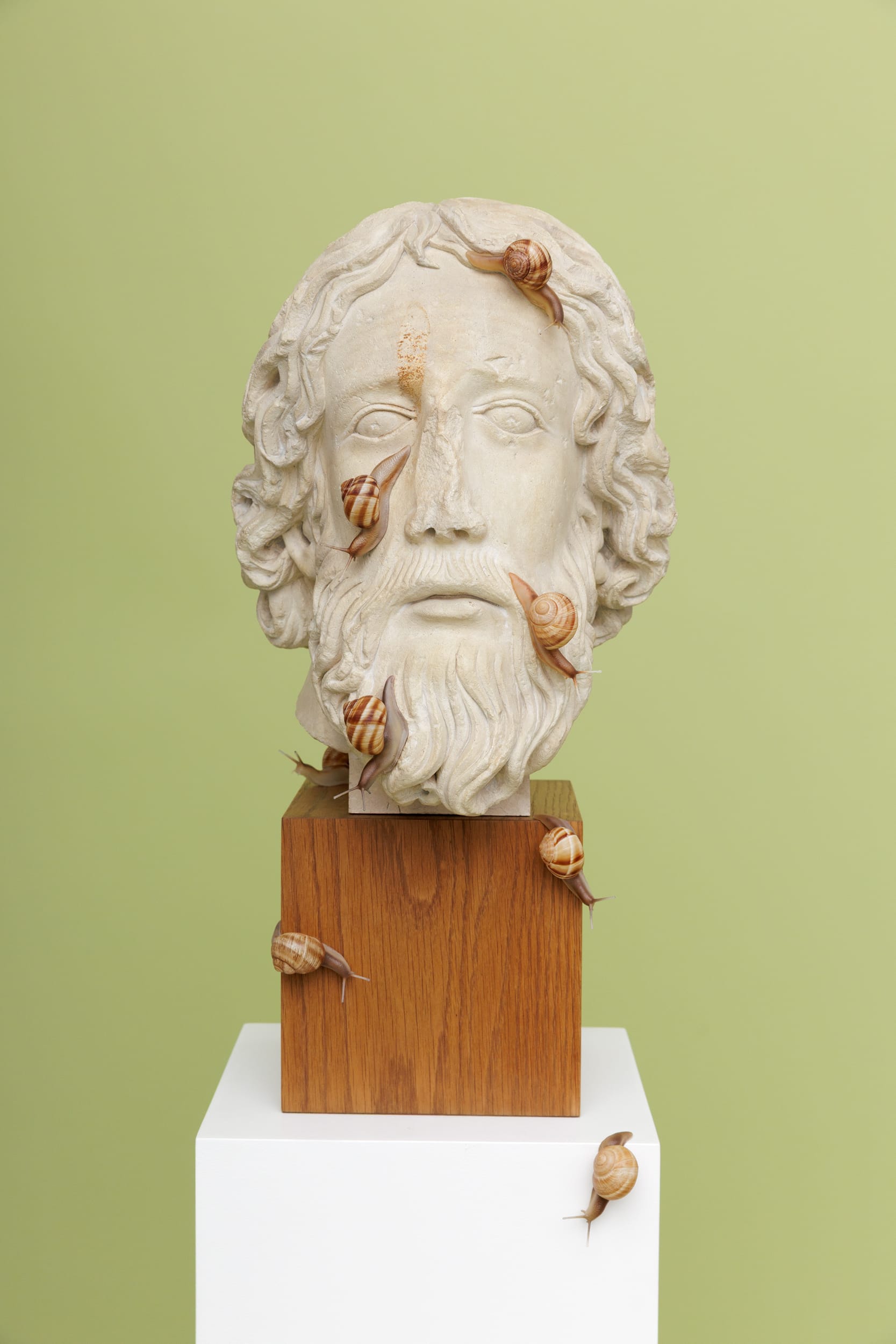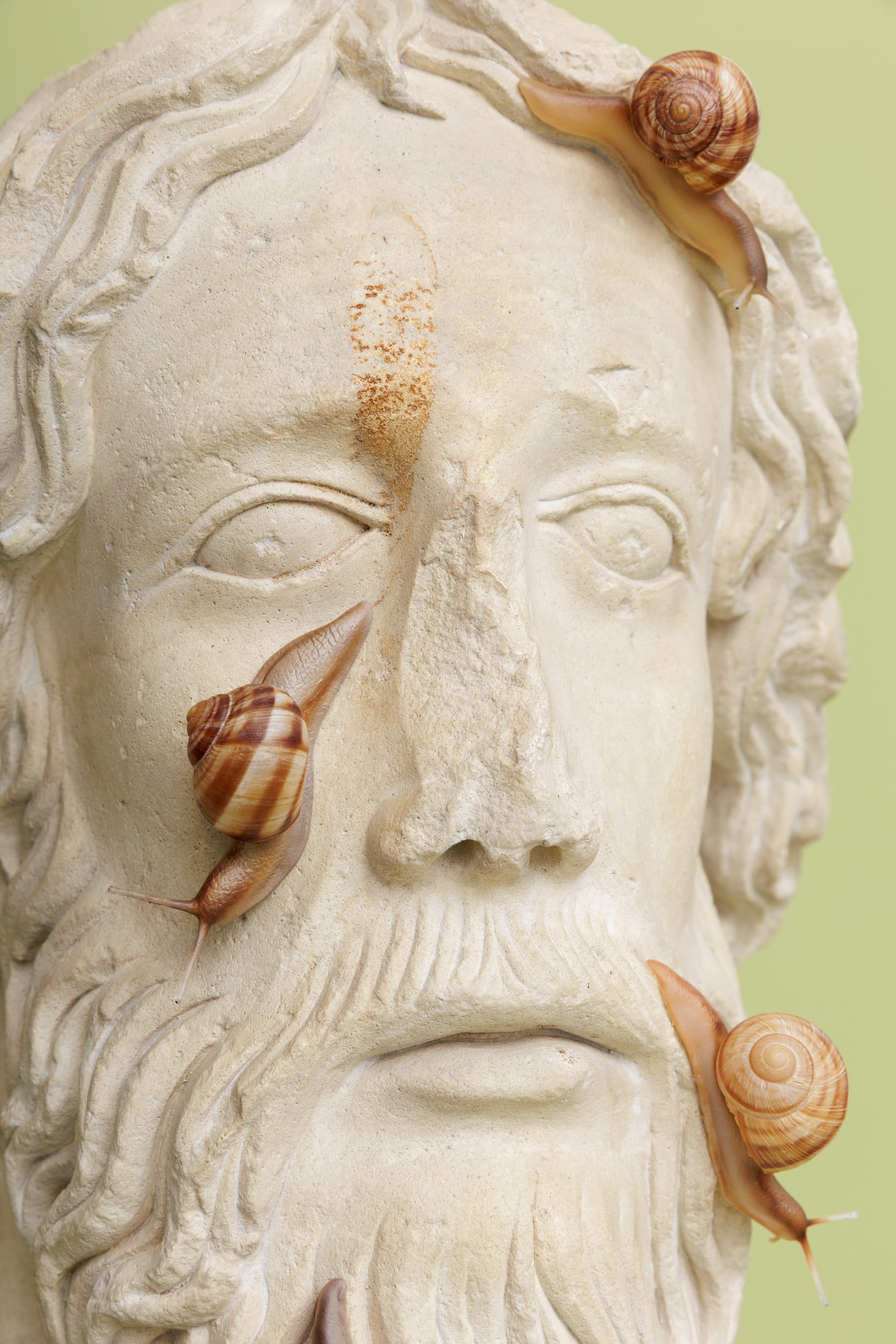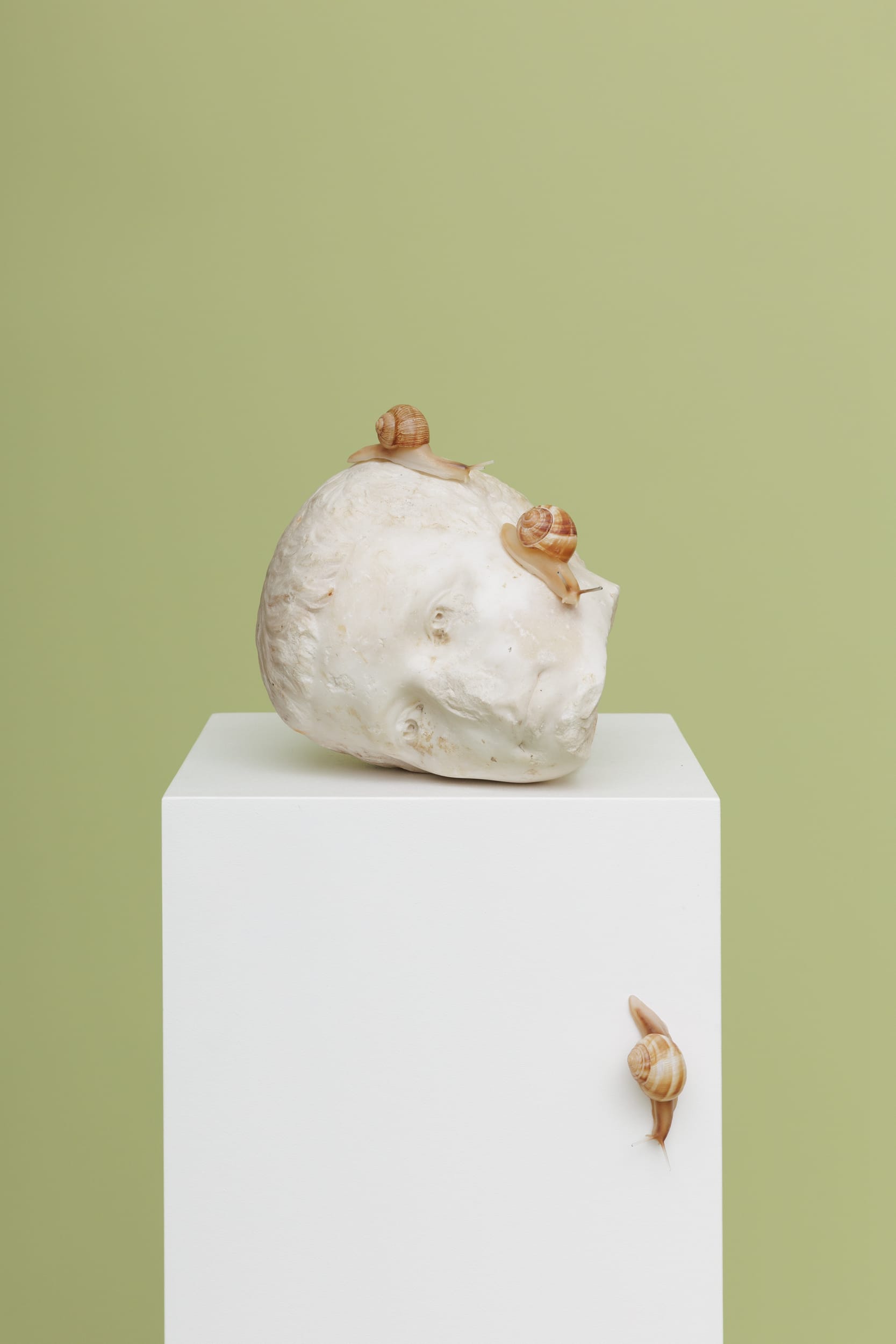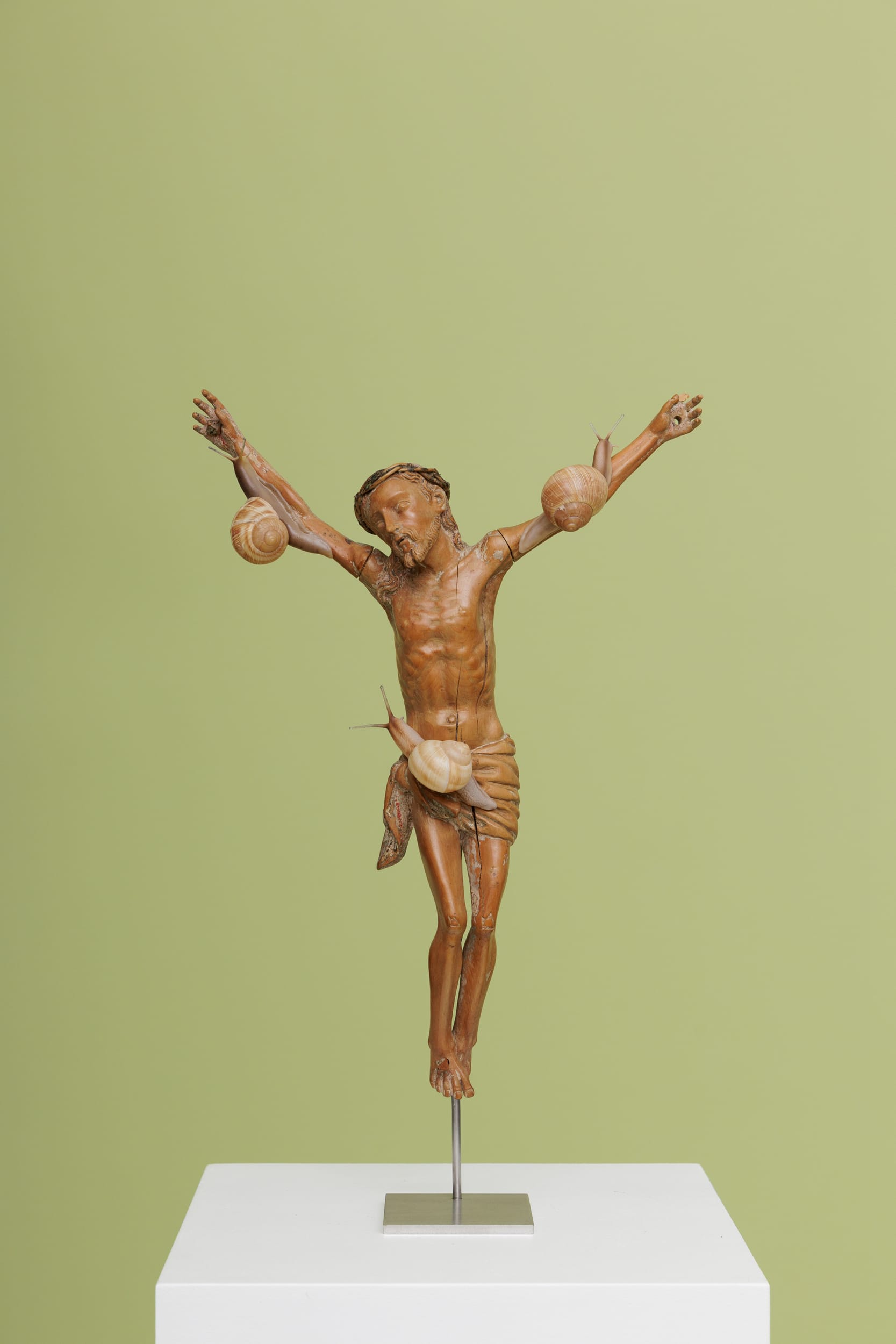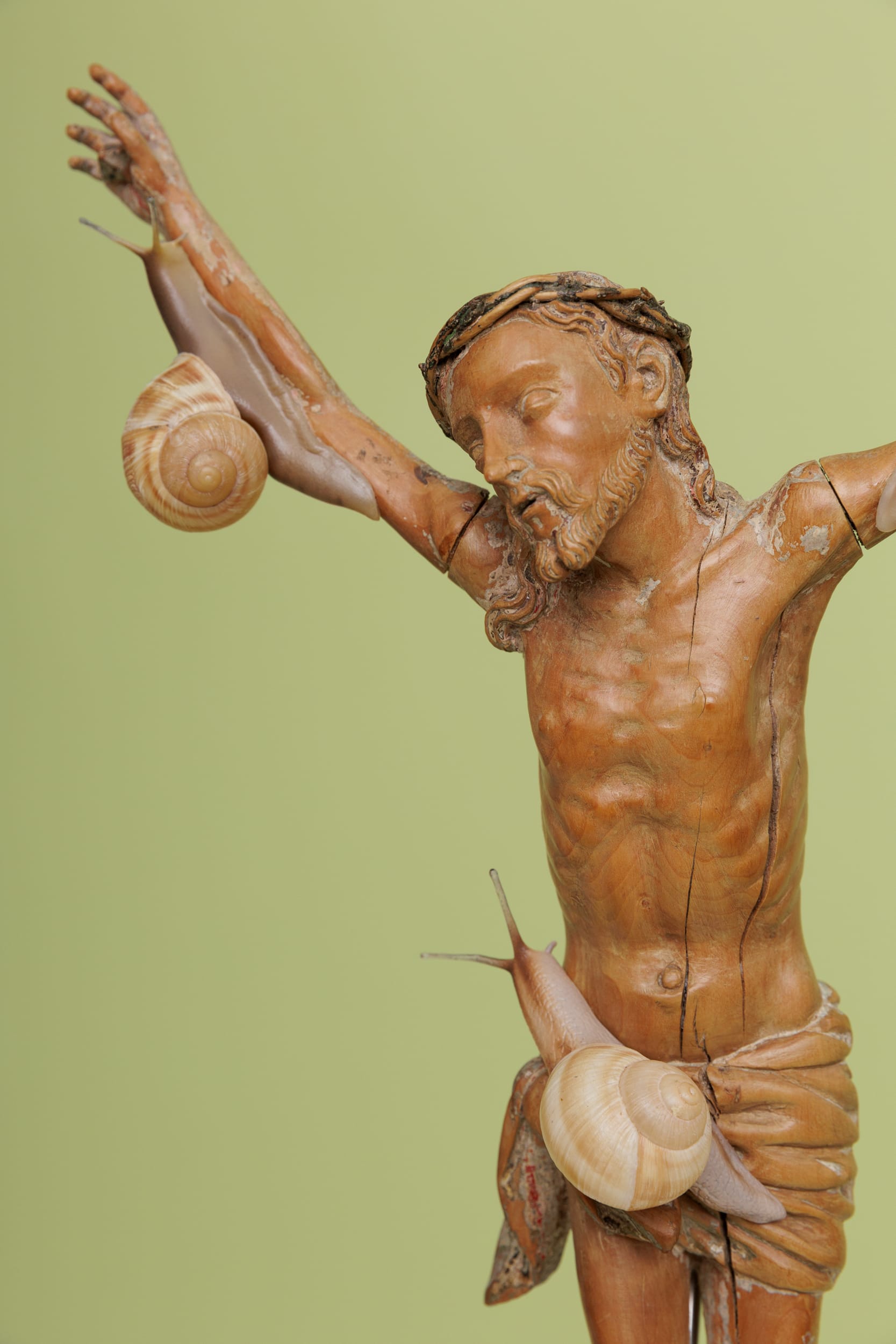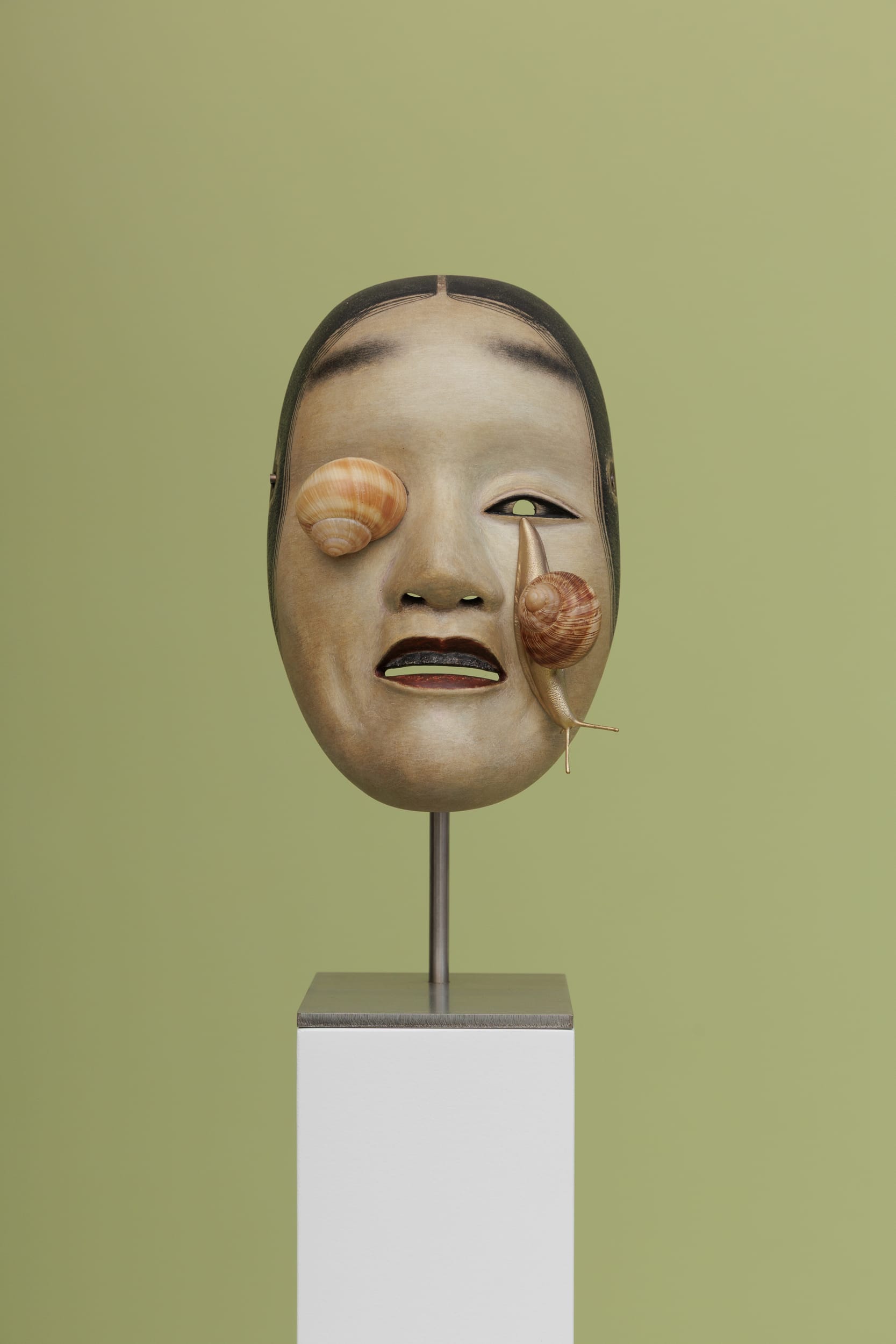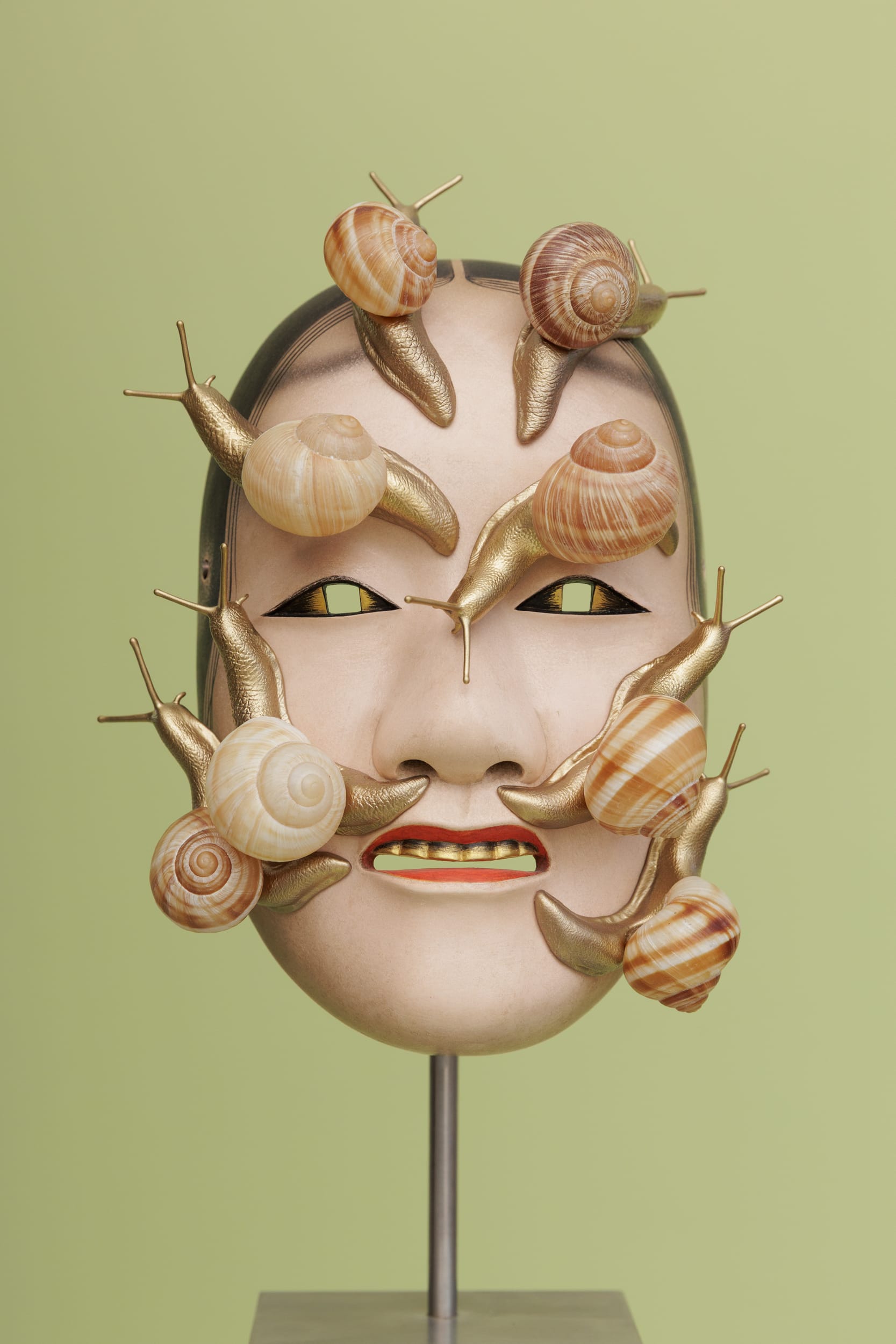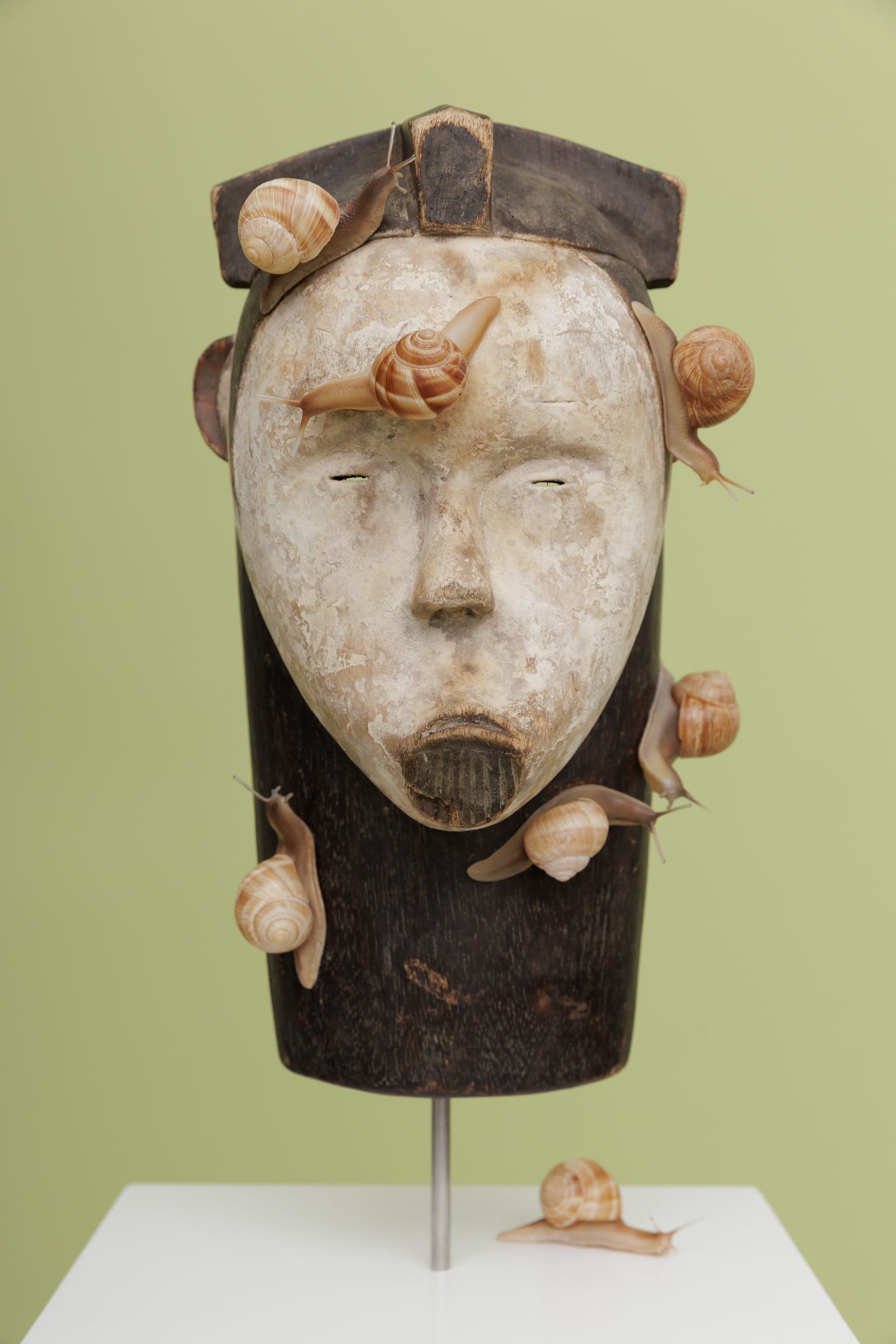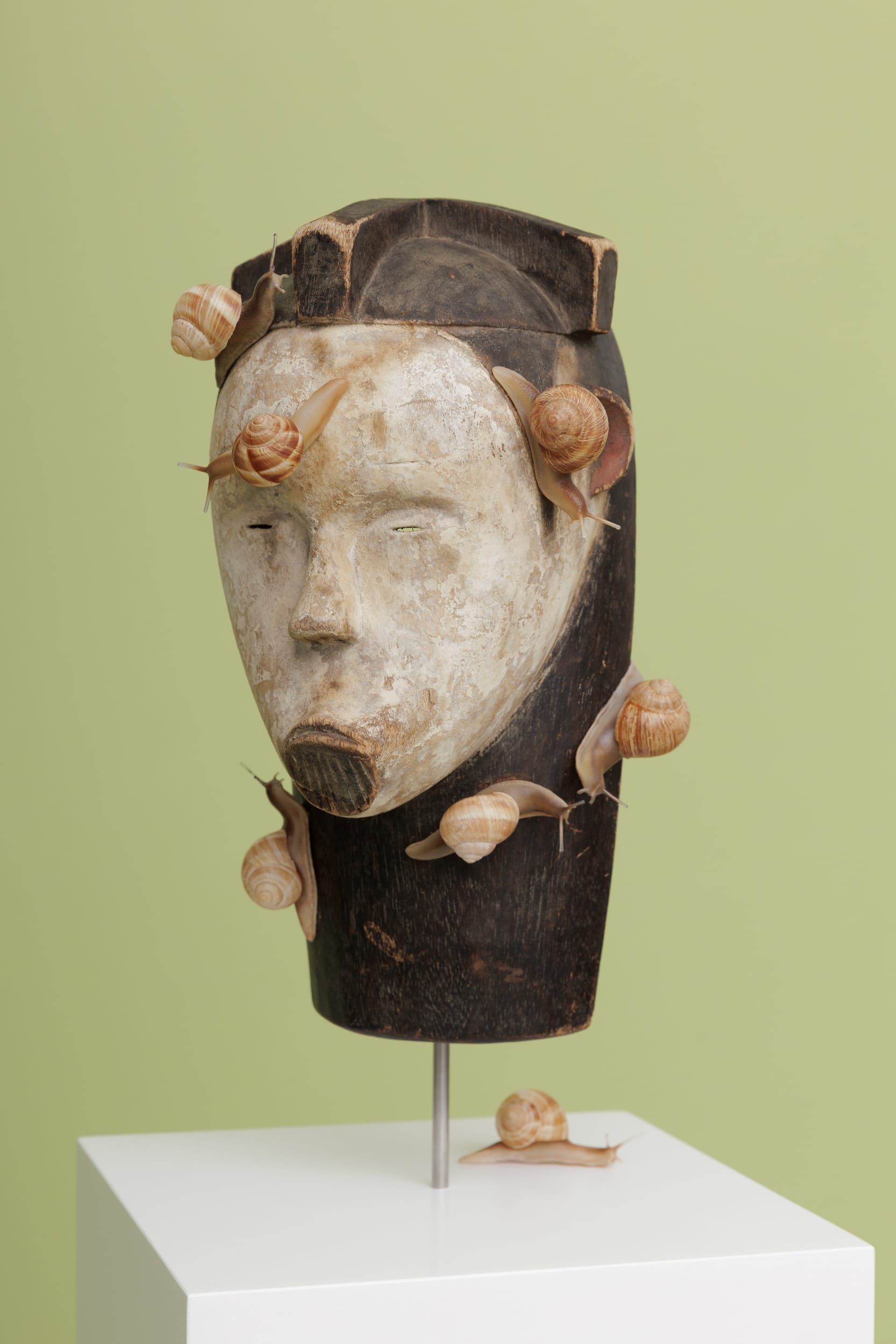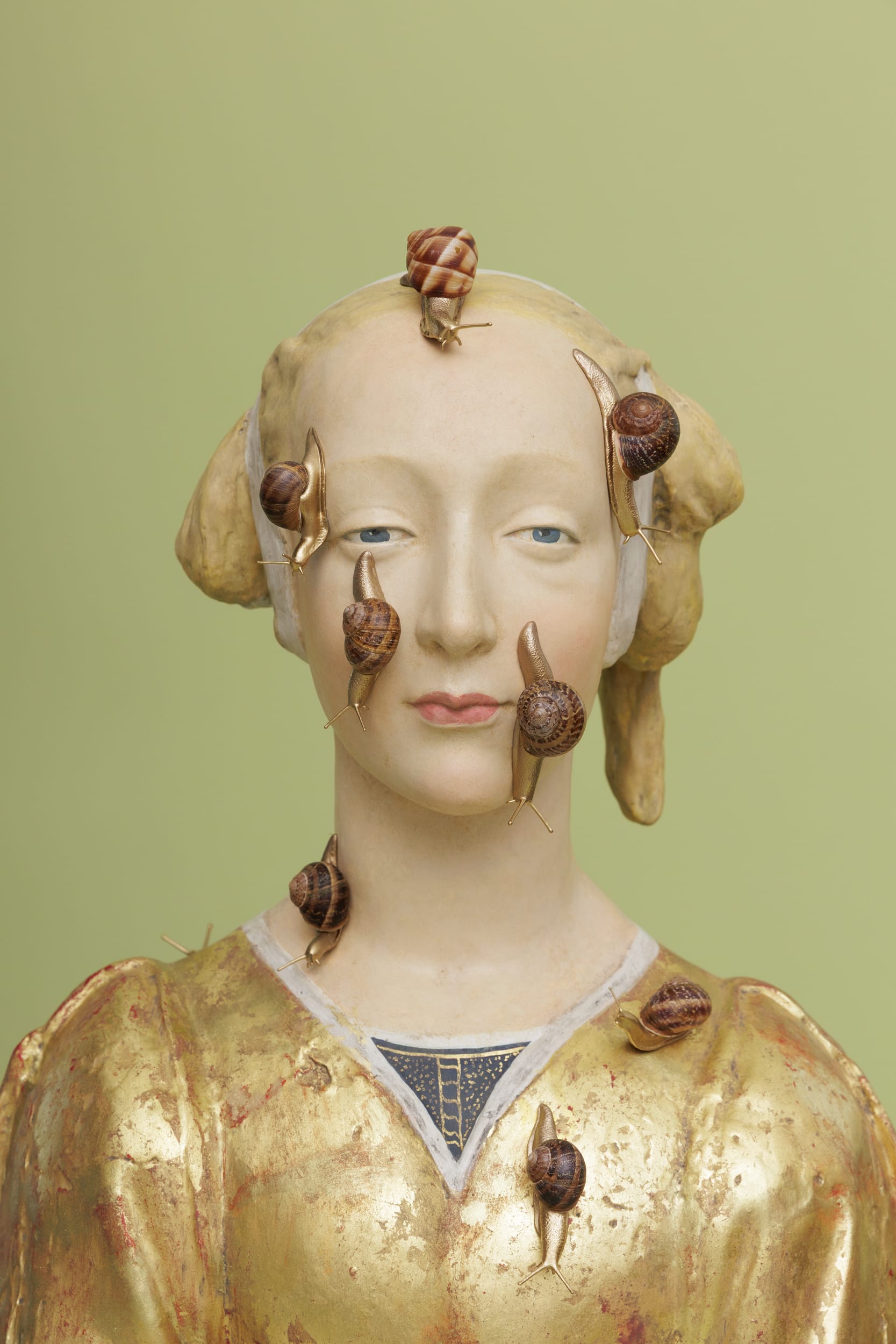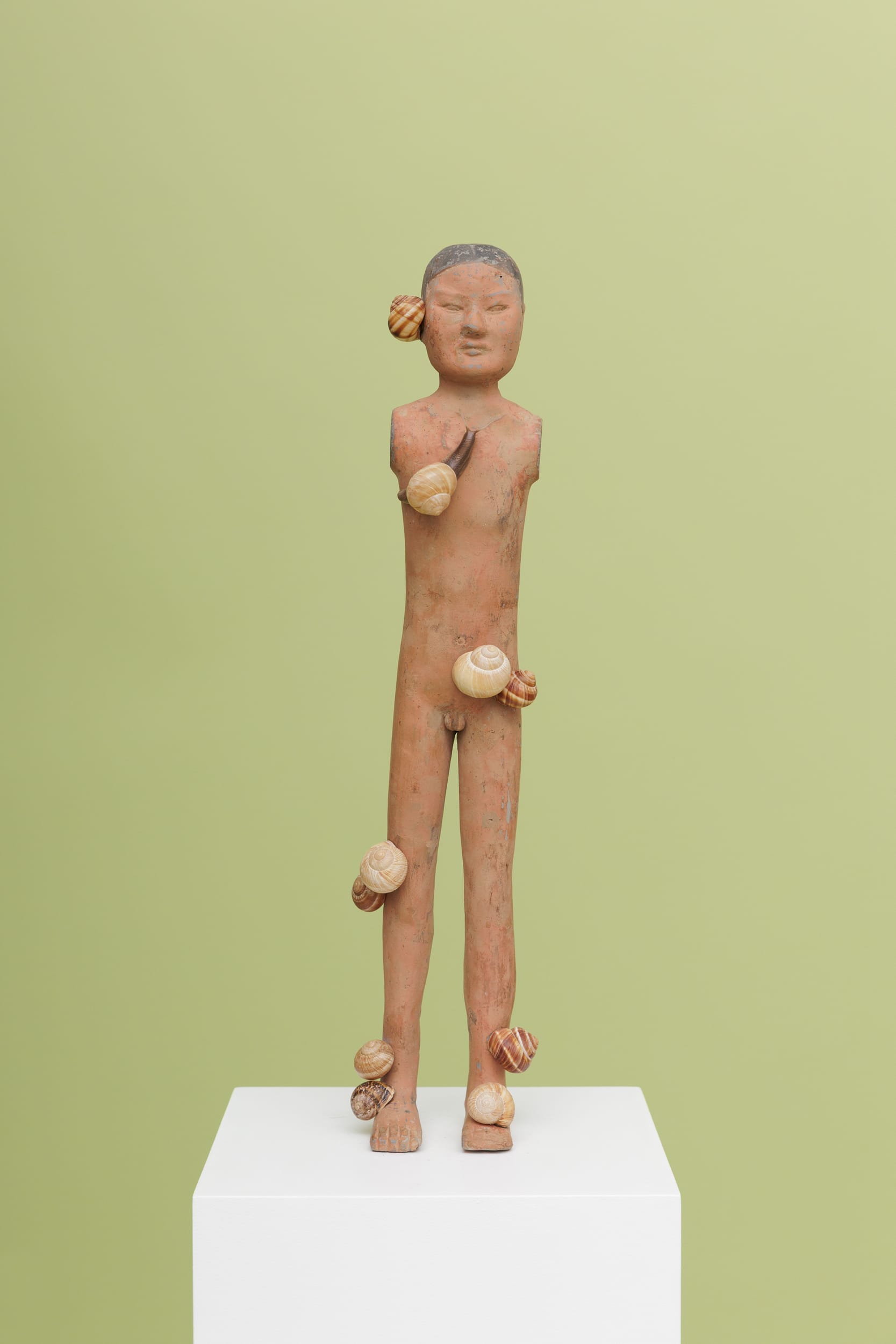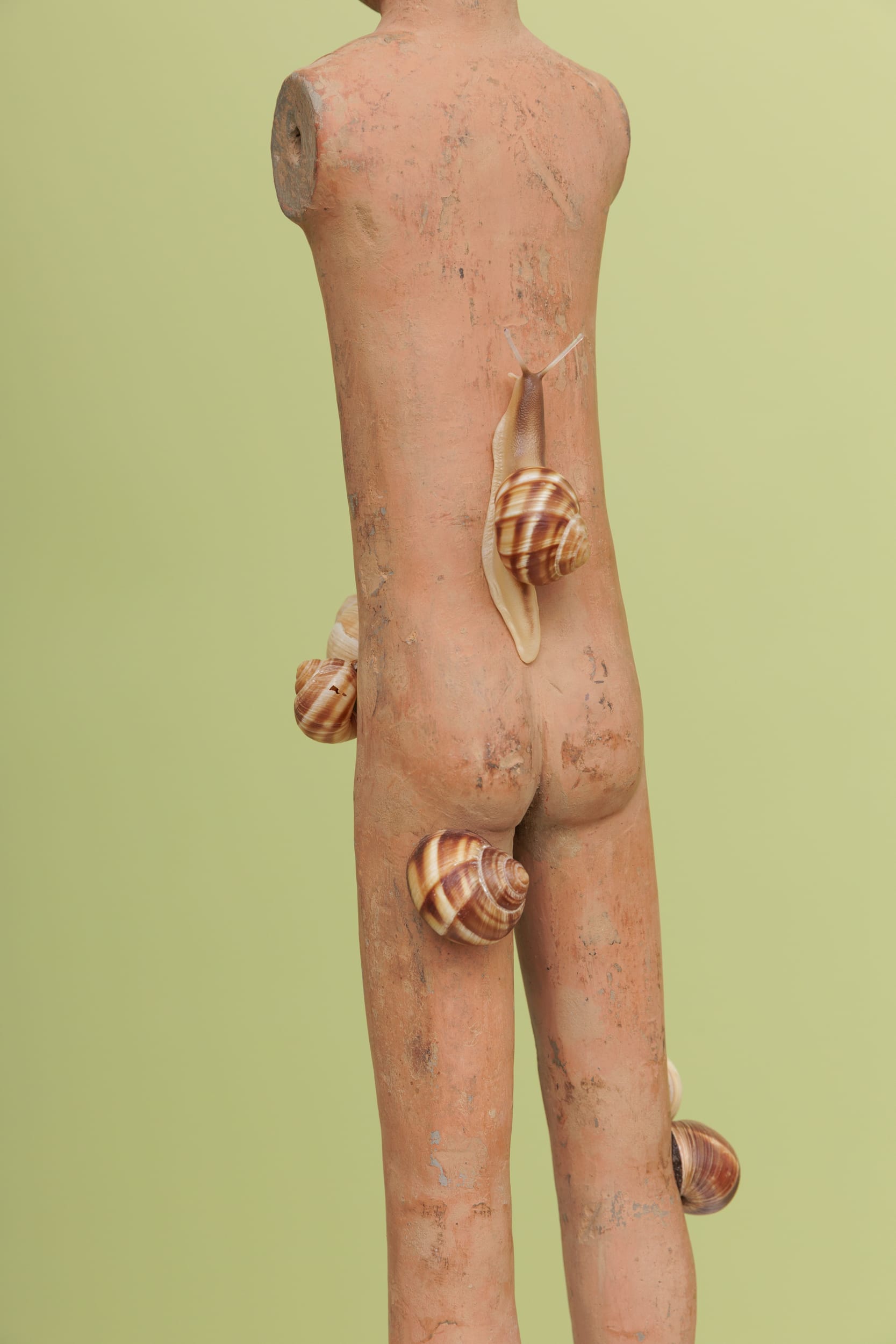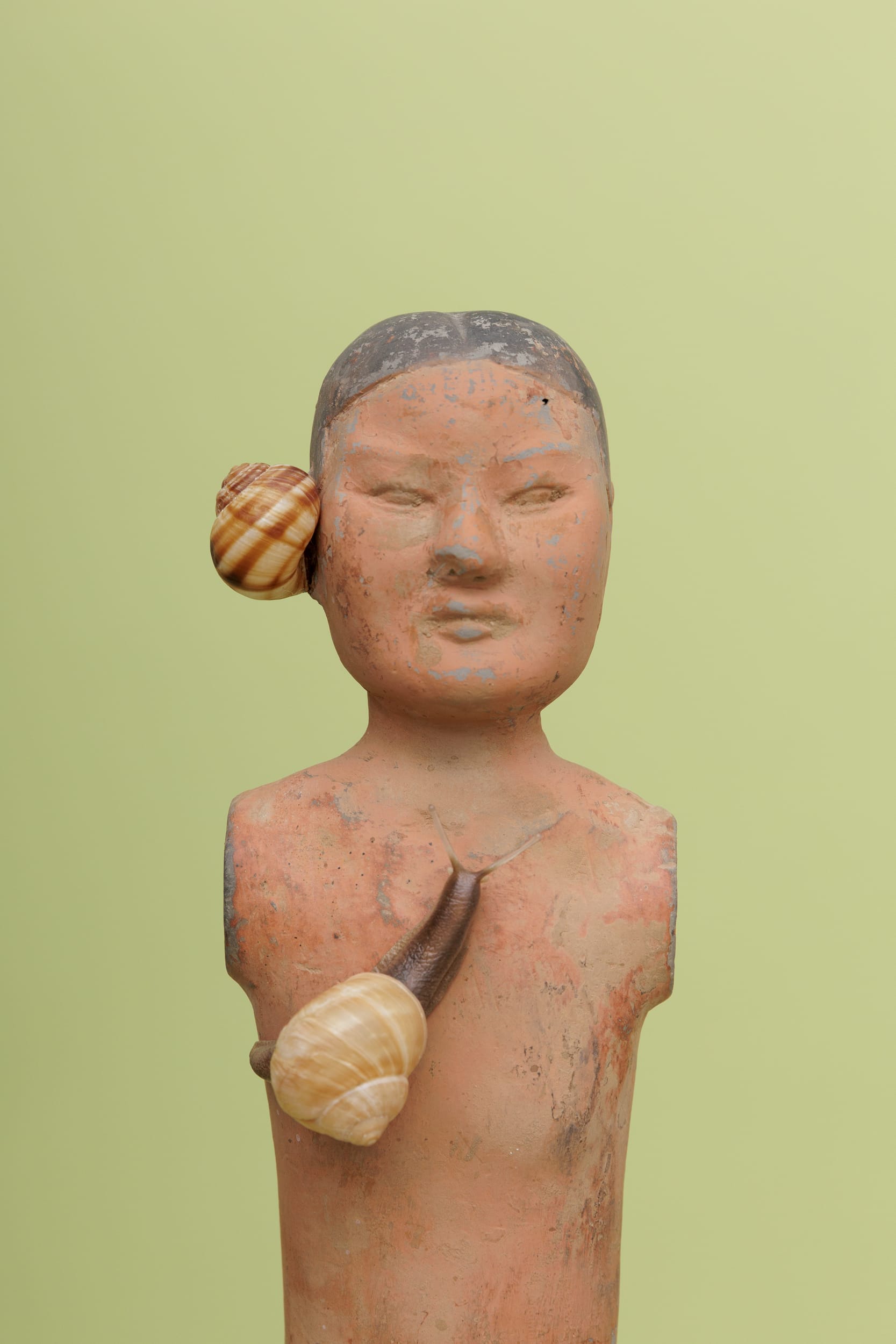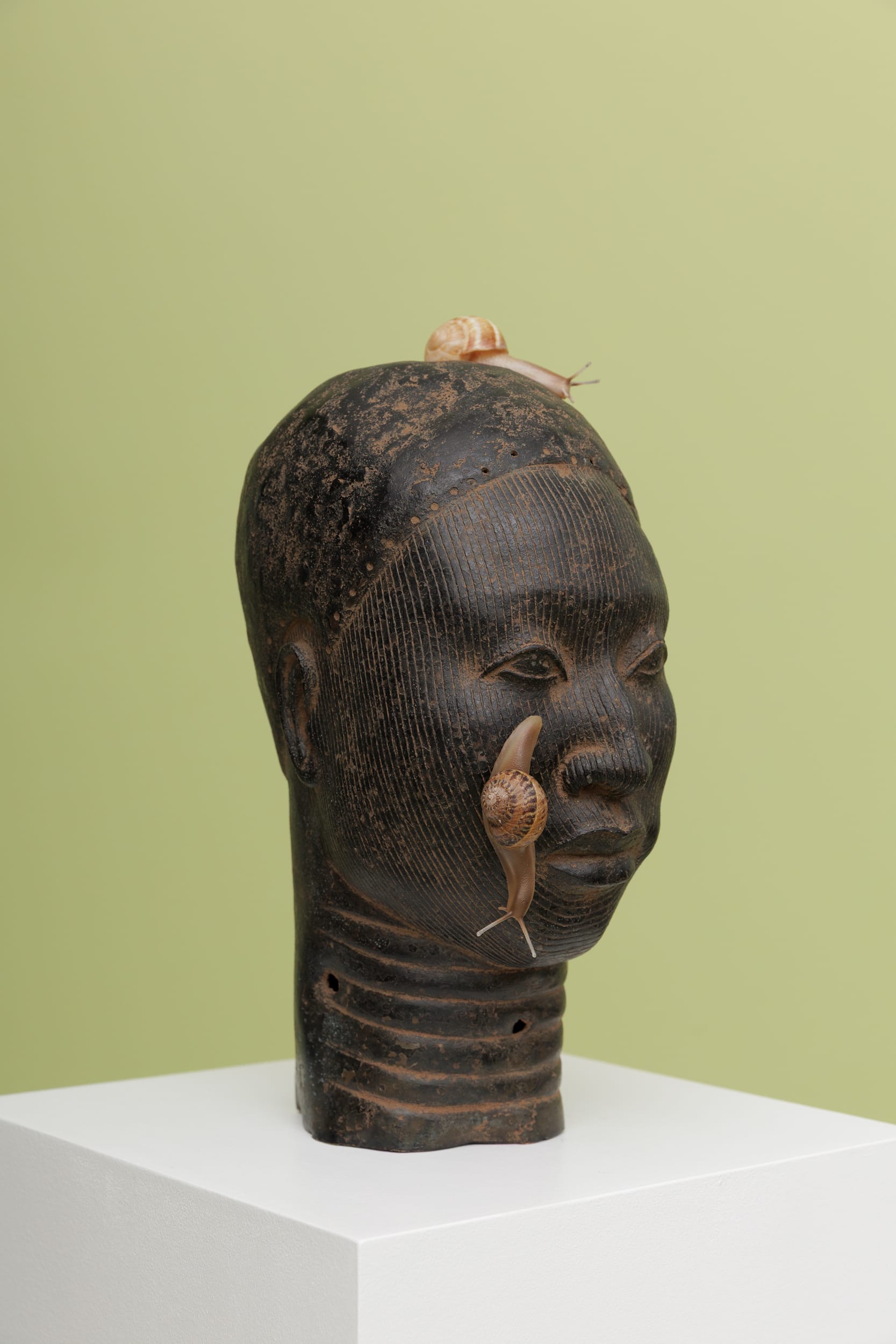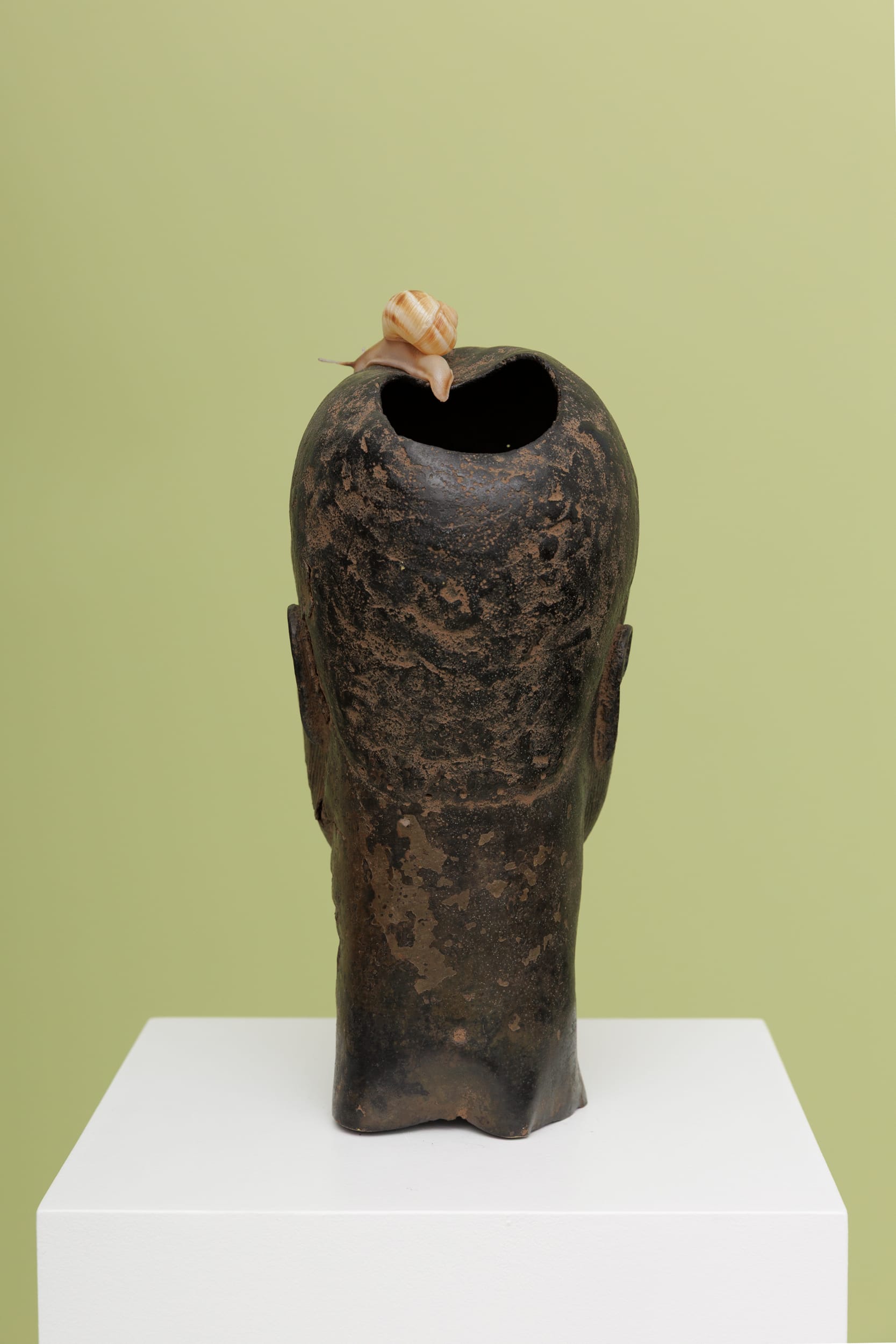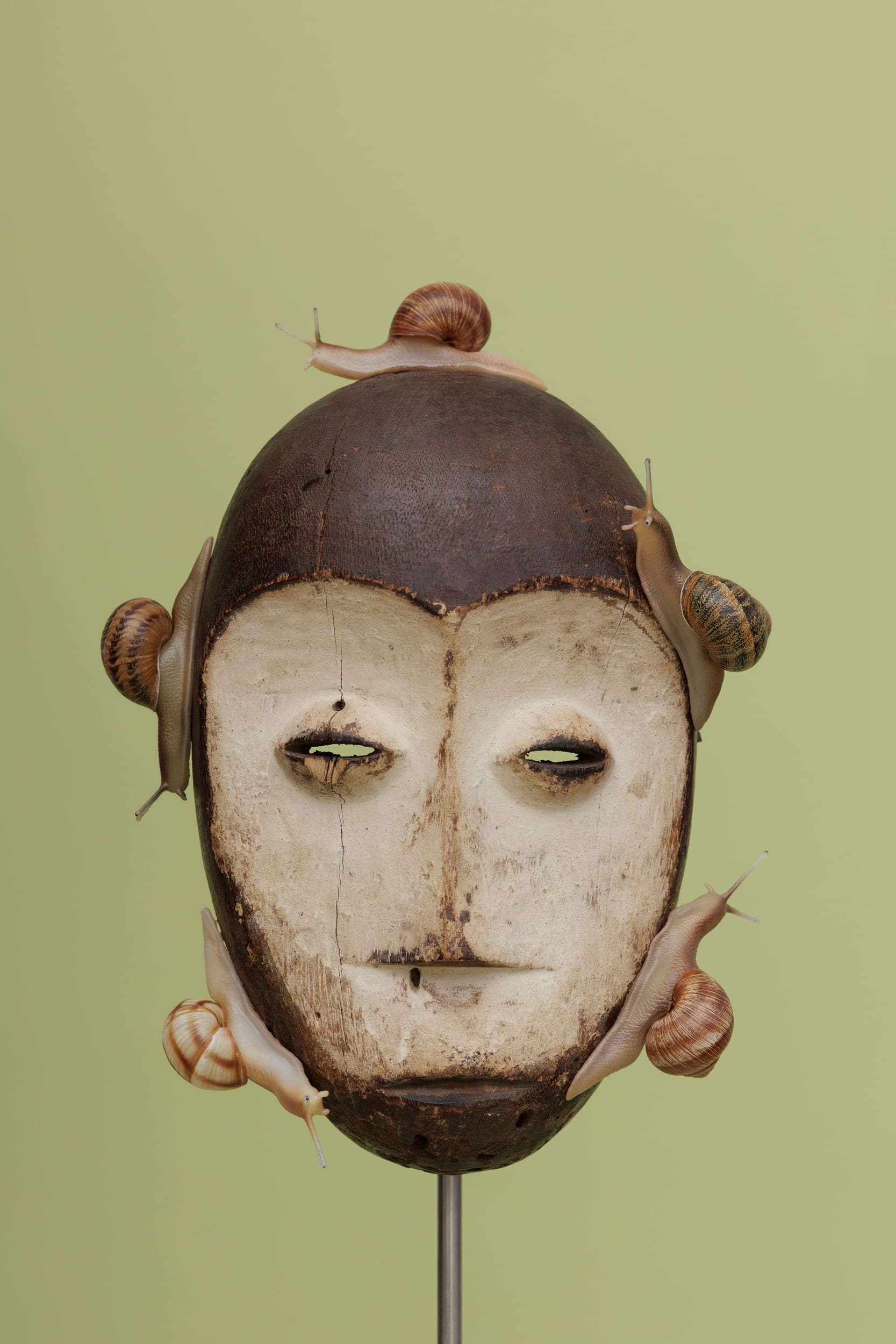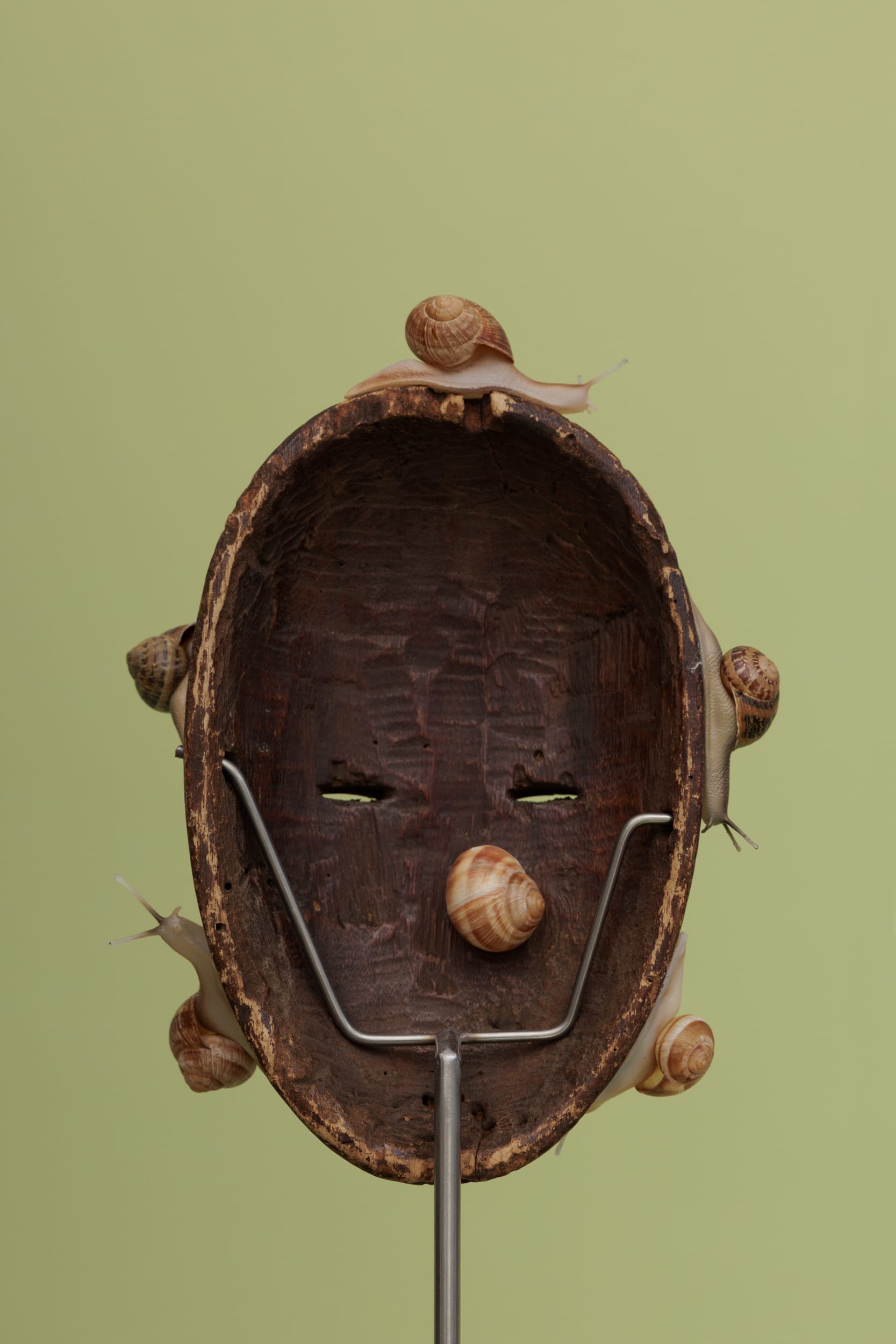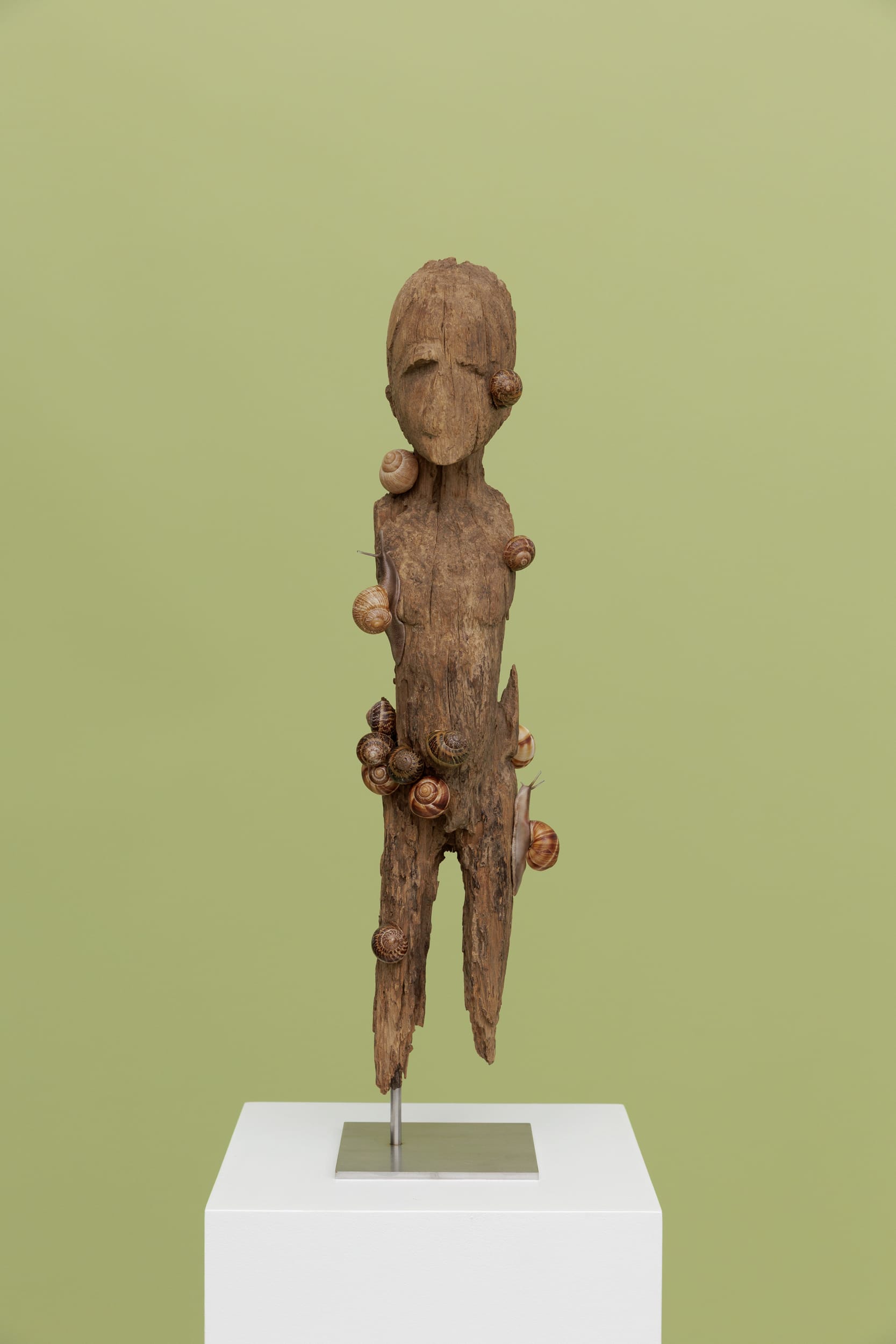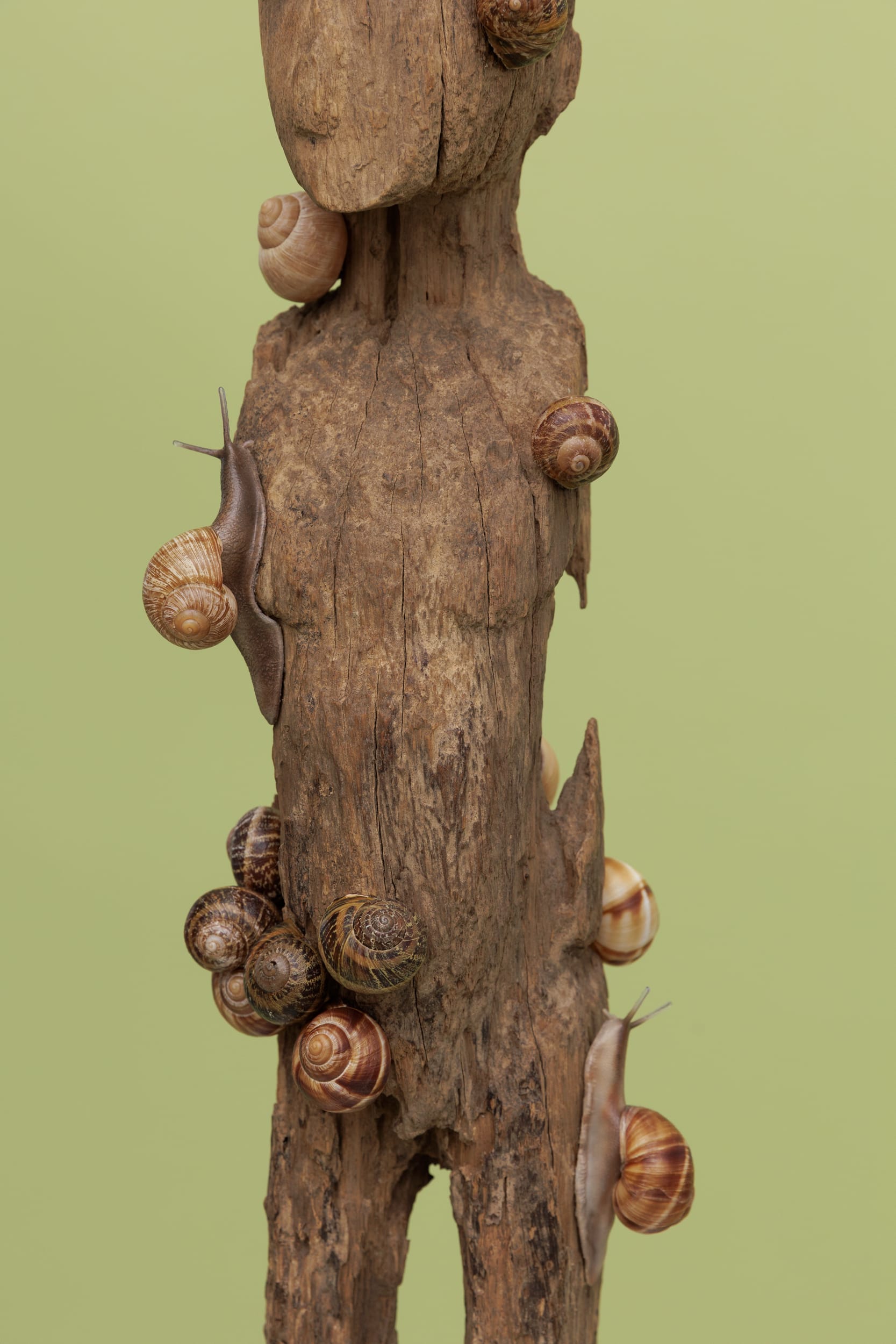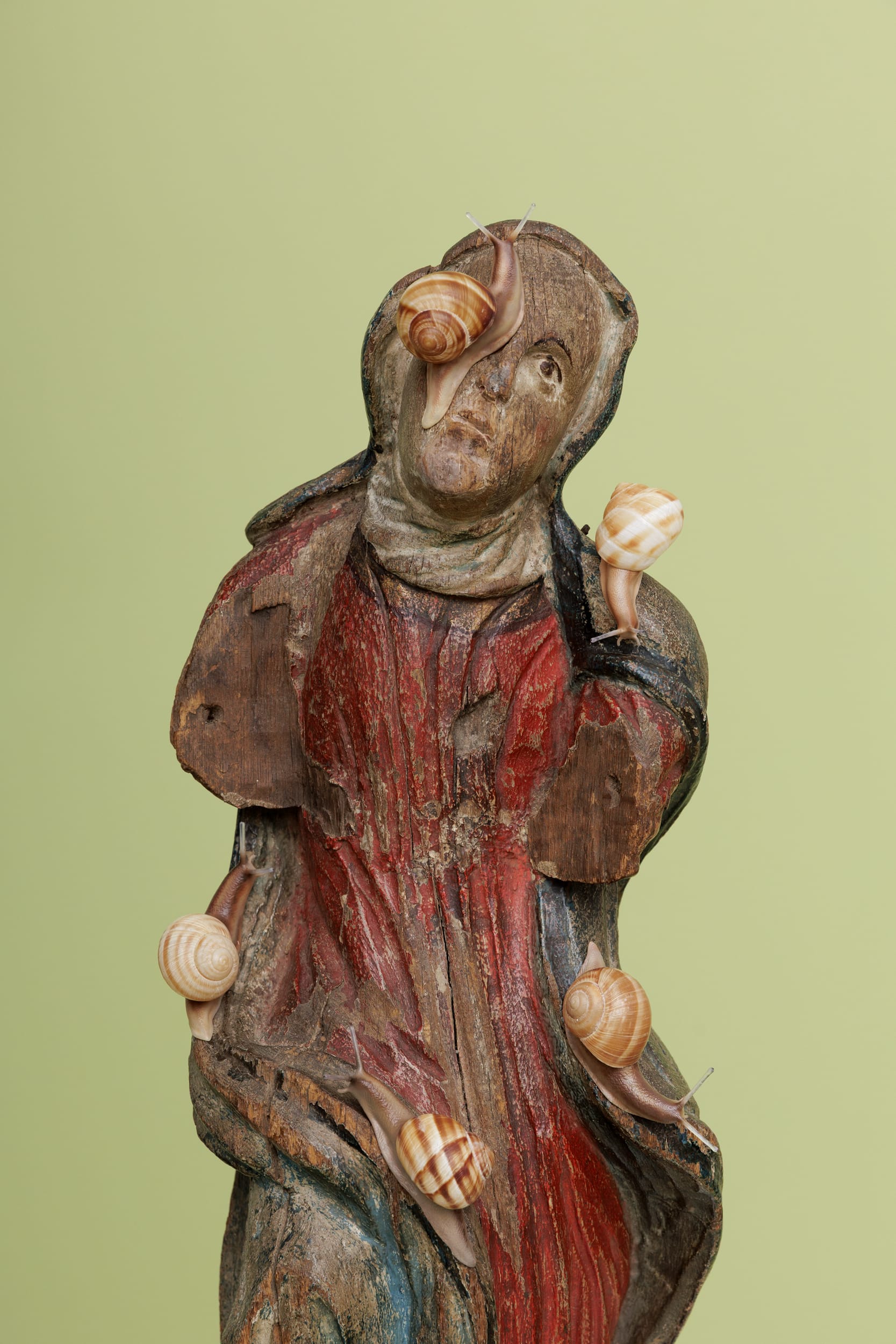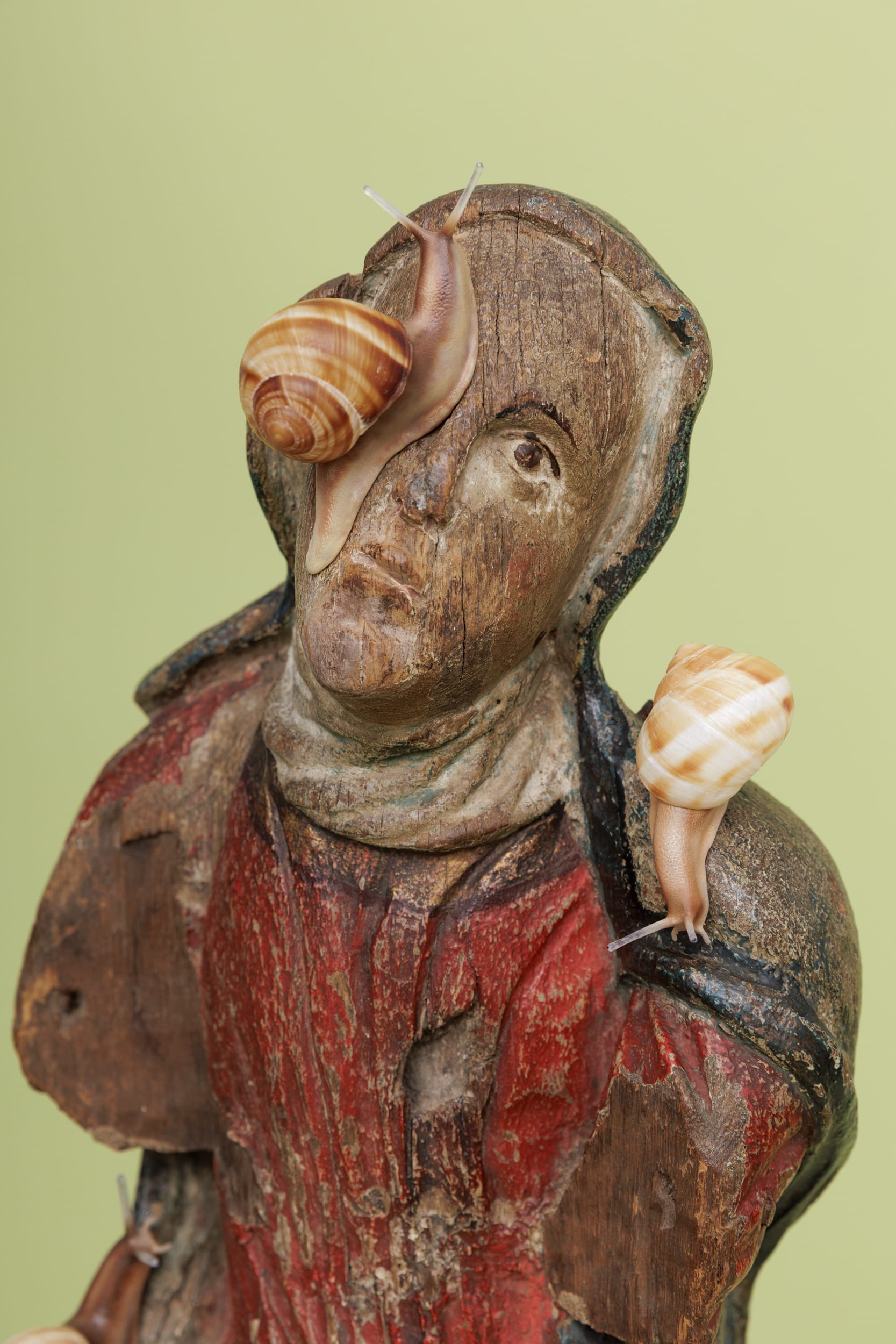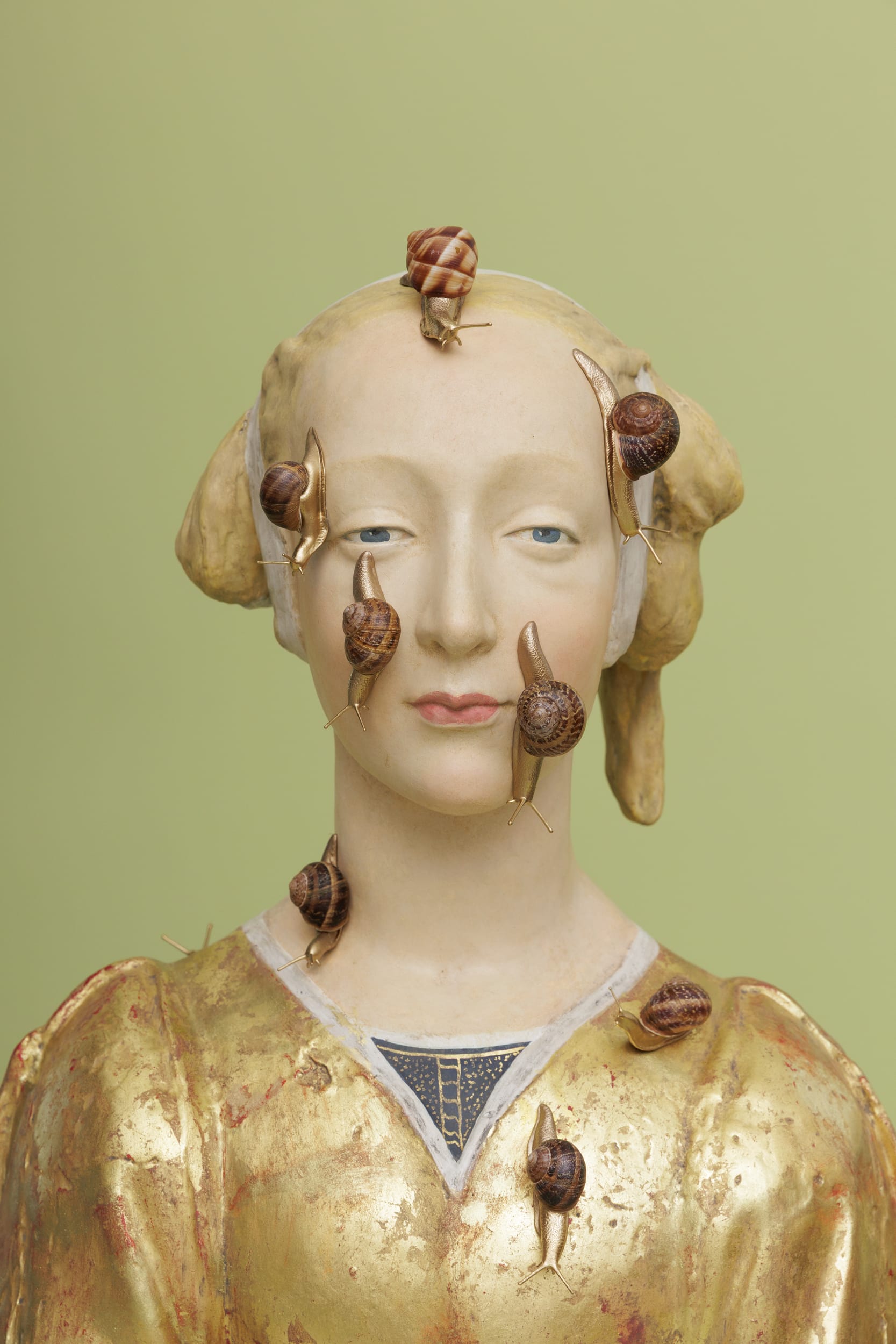
Following Silent Spring (2020) and MIRROR ERROR (2023), “I Swallow Your Tears” is Théo Mercier’s third solo exhibition at mor charpentier in Paris. With this show, Mercier opens a new chapter in his research into the paradoxes of time and fossilized histories. For the first time, he brings together a set of 13 new sculptures entitled “Snail Machines,” in which antiques are invaded by a community of hyperrealistic snails crawling on the surface of their bodies, their bases, and throughout the gallery space.
As is often the case in the artist’s work, this new series begins with a gesture of collection and appropriation. Théo Mercier researched and collected sculptures from antique dealers and art sellers based in Europe. He has thus assembled a unique collection of faces from eclectic periods, techniques, and styles. In the exhibition, visitors will discover a gallery of portraits ranging from ancient Roman statuary to Chinese funerary statuettes, medieval Christian iconography, Lega ritual masks, and Japanese Noh theater masks. Arranged in the exhibition space as if in a face-to-face encounter with art history, these sculptures stare impassively at us, covered in snails under the pale light of LED panels floating above them. Together, they form a front line, or perhaps a chess game placed under observation in a biological research laboratory.
Does this panorama of faces contaminated by strange gastropods suggest that, like the snail, time never goes backwards? Living on a single foot, snails have eyes at the end of their antennae, four lips around their mouth, a single nostril, and more than 15,000 teeth. They drool through their foot, lay eggs through their head, and drink through their skin. With no hair, feathers, or even scales to protect them, they can move up to 170 times their weight, and have always moved in the same direction without ever retreating since their appearance on Earth 541 million years ago—534 million years before the arrival of the first humans. But, like the Cossa snail described by French art historian Daniel Arasse in his book On n’y voit rien (We Can’t See Anything), the snails that crawl through this collection of sculptures invite us to look at the past with a different eye: they are agents of time and space, and their hyperrealistic presence deliberately creates a disturbance in the museum genre.
While snails are now exploited for their regenerative properties in the field of cosmetics, those in “I Swallow Your Tears” appear here as the Trojan horse of a museum turned vivarium. Sometimes healers, sometimes parasites, they invoke rain, break the rules of preventive conservation specific to museums, and turn sculptures into a series of natural landscapes offered up to living creatures. The paths that the snails trace on each of the sculptures are the result of a multitude of mechanisms that are ambiguous in relation to cultural history. Here a traveling snail, there an invading snail, a colonizing snail, a devouring snail, a tumor snail, a repairing snail, a sculpting snail, a jewel snail, or a killer snail, each snail has a special relationship with its object. They cry or suck up the tears of the past from objects, just as they vampirize, heal, drool, or even cover up these stories of spirituality and sometimes violence. Like living tales, relational machines, they are as much vampire snails, leech snails, fluid snails, tears, sex, or caresses.
When humans die, they enter history, said Chris Marker, and when statues die, they enter art: this botany of death is what we call culture. By their mere presence, Théo Mercier’s snails destitute the museum and fertilize objects that would have died in the eternity of the museum when they were separated from their original context. Suddenly, these faces reappear to us alive, crying, questioning, mysterious… And at the same time, their materials reappear to us for what they are: a piece of wood, clay, a fragile surface to be explored.
Is it a coincidence that snails were once found in representations of the Resurrection or funeral images? Snails emerge from their shells after the rain, as the dead will do on Judgment Day. Perhaps this is how, by bringing together the snail and art history, Théo Mercier manages to regenerate the museum object to produce a new kind of Vanitas, one that reminds us that culture, like life, will one day die to be reborn.
Contrary to accelerationist manifestos or even the Slow Movement, the exhibition “I Swallow Your Tears” proposes a politics of the gaze that eschews moral judgment. In an era of great uncertainty, violence, and chaos, the slowness of the snail allows us more than ever to contemplate humanity in its greatest vanity. It offers us the opportunity to enter into a profoundly millennial relationship with time, embracing human history with the blink of an eye of the Earth, considering it to be a history of materials in force and fusion, made up of engulfments and metamorphoses, in which humans are nothing more than a fraction of a second of history.